My Garden (Such as it is)
First off: A note to my faithful “fans:” For more than three months Word Press was mad at me and I couldn’t get here to write. It’s been exasperating because everyone who knows me knows I spout words nonstop utilizing my vocal cords…or my keyboard. Making comments on various social media sites can be somewhat satisfying…as a preventative from exploding…but it’s not the same.So here I am, and what do I want to talk about? My ever-interesting attempts at landscaping. In truth: the list of “What I want to talk about” is long. It was a request from my niece to send photos of my “flowers” that sent me in this direction. Because the flowers in my yard at the moment are sparse. And yet I am excited.
Back in New England
When we moved from Milton, Massachusetts, to Manhattan Beach, we left behind a well loved shady quarter acre we filled with plants we knew and loved (nearly every one had its own story) and a garden that had ben designed/installed by a young man I consider not just a landscape designer, but an artist. 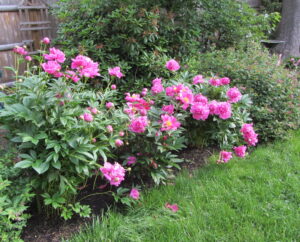 Some of the peonies along the border of the back yard, had been there when we moved into the house in 1977.
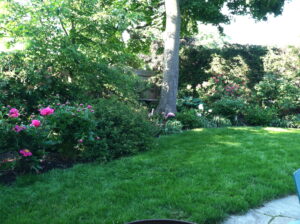 Many of our rhododendrons came from the house where I had grown up. Others from my friend and neighbor, Bette, across the street. When you grow up with rhododendrons you never buy them. You know how to make babies from buried branches. When a tall Norway pine came down–a natural death of old age–we replaced it with a sugar maple so we could have, right in our own back yard, the flaming burst of color makes autumn in New England so spectacular.
A Totally New Climate
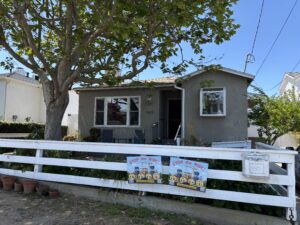 From there we arrived at this sweet little ’50s house with a postage-stamp of a front yard, which had been neatly maintained by a previous owners who didn’t much know or love plants.
After a few false starts, we found a gardener who removed the ugly trumpet vine that our fence fully wrapped in a death grip and replaced it with a border of lace cap hydrangeas and a couple of other plants I still don’t know the names of.
Then came the drought. At a time when we were being asked to limit ourselves to five-minute showers, it seemed pretty silly to be watering a front lawn. Back in the day, in New England, if it didn’t rain for a while in the summertime, the grass turned brown. Along came the rain, and the grass turned green again. That’s the way it was.
Here in Southern California, homeowner seem to think green grass is a necessity. To the point where they are willing to empty every reservoir between here and the Colorado River…and the Colorado River itself…to have a green lawn. (A thousand times worse: they give up the effort, tear out their grass and pay God-knows-what to install artificial turf; in other words: plastic grass. (So I’ll save my tirade about plastics/microplastics for another day and continue).
Nature’s Best Hope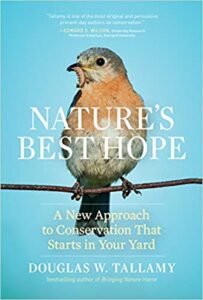 A good friend from back home had been to an inspiring presentation at the Arnold Arboretum (a place the two of us loved to meet up, walk and talk) by Doug Tallamy, entomologist, ecologist, conservationist and a professor at U Delaware. His message, in short work with, not against, Mother Nature by growing plants that are native to the place you live. This is the landscape that will thrive best and also best support the birds, bees in your local entire ecosystem. I bought and read the book. I was hooked!
Only problem (well, one of many actually): Hydrangeas (which I love) are not native to Southern California. In short, they don’t belong here. Neither, unfortunately, do the fescues and bluegrass of just about every lawn. (Sigh)
What to do?
I’m still puzzling it out. In the meantime, we’ve made a start.
Our Fledgling Project
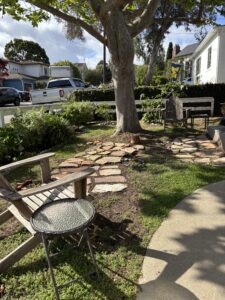 This is it! Our front yard. Its highlight is the sycamore tree that gives us shade. And since grass prefers sunshine to shade, our lawn was never a wonderful success. But turn off the irrigation that waters it for several years and it gradually makes its retreat. The Adirondack chairs were a gift. The tables hand-me-downs from people who moved and left them behind. And then I discovered the pavers–half buried many layers deep among overgrown shrubbery and weeds on the space between fence and street in a property slated to be torn down. A few at a time, those pavers made their way to our driveway where they sat for quite a while, as I pondered. Finally, inspiration struck. So now we have a little half-moon patio replace what had become a patch of bare dirt. And a second mini-patio just big enough to serve as a base for the two Adirondacks positioned side-by-side. OR: for my new hammock, a twin to the one left behind in Milton.
Butterfly Interlude
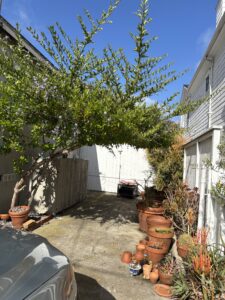 Before we could address the situation in the front yard, I wanted to actually plant some of the seeds I had (overoptimistically) purchased. Our grandson helped me plant pole beans, radishes, plus carrots and dill (hoping to attack the Swallowtail butterflies we had last year.) We lined up our pots at the end of the driveway.
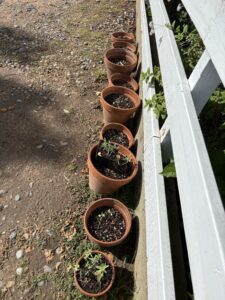
And then, we had a butterfly emergency to deal with. I had only one milkweed plant left over from last year. It was doing nicely. So nicely that it attracted a Monarch Butterfly…when we weren’t looking. And suddenly, we had ten tiny caterpillars to look after. They were chomping fast. Too fast. I rushed to the nearby Garden Center and purchased several pots of narrow leaf milkweed; I’ve read enough to know that the non-native “tropical” milkweed can actually be harmful to the Monarchs because of a parasite it harbors. (Oh, dear, so much to be aware of!)I planted native milkweed seeds. Mission now accomplished, along with seven tiny neighbors ranging in age from one to five years, we’ve watched the caterpillars get fat, make their chrysalises, and eventually fly away. That was May.
UPDATE: June 1, 2016
Now we’re into June and back to the front yard. It’s not exactly beautiful. (Yet!) But at least we’re not wasting water trying to maintain a green lawn. And we’ve begun the transition to California native plants.
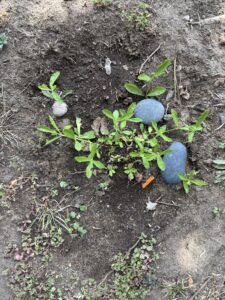
It’s called Lippia (Common Lippia, or Turkey Tangle Frogfruit; Phyla Nodiflora for the horticulturists). I discovered it by visiting Manhattan Beach’s native garden here in Polliwog Park. It’s cared for by volunteers. I walked around on a Friday morning when the volunteers were there. After spying this low-growing ground cover, I told the woman in charge what I was hoping to do and she assured me that this plant might be what we wanted. She warned me that it was “very aggressive,” and that was music to my ears.
Being obsessed with the idea of using native plants, I scoured a couple of nearby nurseries and had no luck. A friend in my book group told me about The Theodore Payne Foundation–a local legend. It’s a nonprofit “dedicated to the understanding, preservation, and use of California native wild flowers and plants. Its mission is to “inspire and educate Southern Californians about the beauty and ecological benefits of native plant landscapes.https://theodorepayne.org
Sure enough, I got onto the TPF website and there it was. The description made me hopeful that THIS would be our new LAWN: “An attractive matting ground cover…that “tolerates foot traffic; makes a good lawn substitute. (Best of all, its numerous small flowers attract butterflies.) Yes! I ordered several 4-inch plants and we drove the 36 miles across the San Fernando Valley to pick them up.
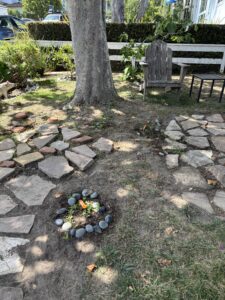
I’m in the process of planting them. (With the help of an eight-year-old grandson who enthusiastically attacks the rock-solid compacted, dry earth here to dig me a hole big enough to get them started. He has also told me he wants to dig a much bigger hole–“big enough for me to sit in.”
Stay tuned!